What Is a Landing Page? Parts, Examples and Uses

Bakslash editorial
November 6, 2026
Comparte este artículo
A landing page is a web page you create to get visitors to take a specific action, such as requesting a quote, buying a product, or registering for an event. You present one offer and a primary call to action. Visitors can arrive through ads, emails, social media, or search.
What is a landing page used for?
You can use a landing page to present a service to people with a specific problem and give them a next step. If you offer accounting advice, for example, you could create a page for requesting a review, explain what you will check, and ask for the details you need to reply.
We call that target action a conversion. A form submission can count as a conversion, but you still need to assess whether the contact meets your sales criteria. Track inquiries, opportunities, and sales as separate stages.
In analytics tools, “landing page” can also mean any page through which someone enters your website. In this guide, we mean a page you prepare for a specific offer and conversion goal.
How does a landing page differ from a website or a one pager?
A landing page can be part of your website and use the same domain. The distinction comes from what you want the visitor to do.
| Format | What you use it for | What visitors can do |
| Website with multiple pages | Present your company, services, and resources | Explore sections and compare options |
| One-page website | Present a business or proposition on a single page | Scroll through sections |
| Landing page | Present an offer with a conversion goal | Inquire, buy, download, or register |
| One-page document | Summarize a project on one page, such as a PDF | Read and share a brief overview |
You can design a one-page website as a landing page by focusing its content on one offer and one primary action. You can also build a one-page company website that presents several services. Using a single page does not determine its purpose.
For the presentation document, read our guide to what a one pager is, with examples and how to write one. For a website built around inquiries, explore the scope of our one-page website and landing page service.
What are the parts of a landing page built for conversions?
Start with the questions visitors bring: what you offer, who it is for, and what they will receive when they take the next step. Use these parts as a guide and adjust their order to fit the offer.
Headline: explain what you offer
Write a heading visitors can connect to the ad or link they followed. For an accounting service, “Accounting advice for businesses that sell online” tells readers more than “Take your business to the next level.”
Avoid promising results you cannot demonstrate. A precise headline also helps readers decide whether the service fits their needs.
Value proposition: explain what visitors will receive
Describe the problem you address, the scope of the offer, and the relevant terms. In the accounting example, clarify whether you will review invoicing, reconciliation processes, or outstanding obligations.
Include the price where appropriate, or explain what you need to know before providing a quote. Use product images or work samples when they help visitors evaluate the offer.
Social proof: show evidence you can support
Include testimonials you have permission to use, documented case studies, or reviews with a source readers can check. Explain what work you did and its context.
If you do not have testimonials yet, show a demonstration, a sample deliverable, or your team's verifiable experience. Avoid making up clients, logos, or satisfaction figures to fill this section.
Call to action: name the next step
A call to action, or CTA, tells visitors what to do next. Use a label that describes the action: “Request a review,” “Save my seat,” or “Download the guide.”
You can repeat the same CTA after explaining the offer and near the end of the page. Keep the same objective and retain useful links, such as privacy information and terms. If you give buying and requesting a quote equal prominence, readers will need to choose between two different processes.
Form: ask for what you need to handle the inquiry
For an initial inquiry, consider whether you need a name, email address, and description of the problem. Add budget or company-size fields when your team uses those details to handle or qualify the inquiry.
Explain how you will use the information and link to your privacy policy. Keep a contact request separate from a marketing subscription. After submission, confirm receipt and explain the next step.
A sales landing page can lead to checkout instead of a contact form. You can also offer a downloadable file without asking for personal details.
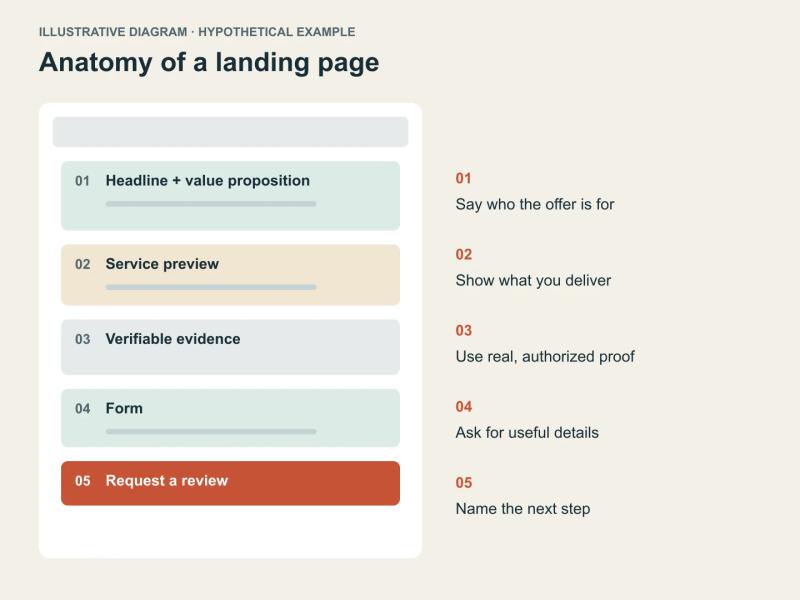
Illustrative diagram: adapt the order and fields to your offer.
What types of landing pages can you create? Four examples
These landing page examples are hypothetical. They illustrate content choices and do not represent Bakslash clients or measured results.
Lead generation: request an accounting review
An accounting firm wants inquiries from businesses that sell online. On the page, the firm describes what it covers during the review, who performs it, and how it will contact the person.
Visitors find a “Request a review” button and a form asking for their email address, business type, and reason for contacting the firm. The team records each inquiry as a contact, then assesses whether it can help.
Sales: buy a recorded workshop
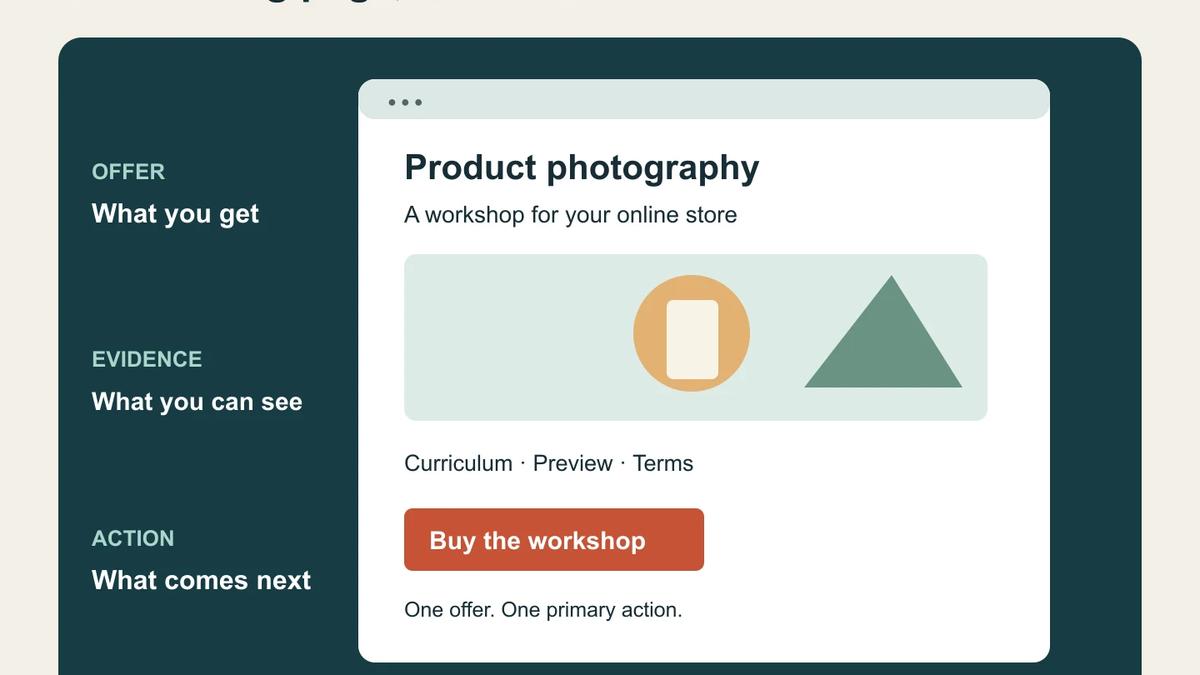
A photographer offers a product photography workshop. The landing page includes the curriculum, a sample lesson, the price, and access terms.
The “Buy the workshop” button leads to checkout. Visitors can review requirements and refund terms before purchasing. The goal is a completed purchase, rather than a click that opens checkout.
Events: register for a webinar
A company runs a webinar about organizing sales follow-up. It lists the date, time and time zone, speakers, and topics.
The “Save my seat” CTA leads to the registration form. After submitting it, visitors receive confirmation and instructions for joining. The organizer can measure registrations and attendance as separate actions.
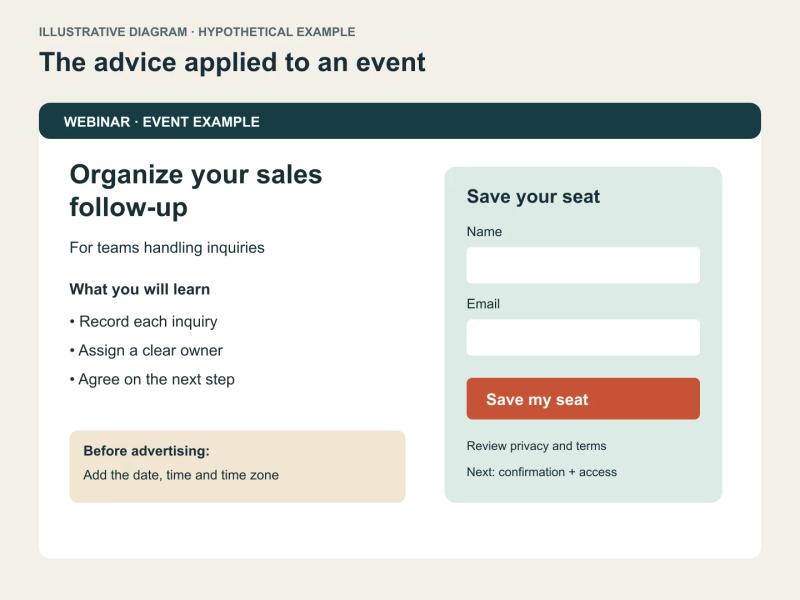
Hypothetical example: add the date, time, time zone and terms before advertising the event.
Downloads: get a budget template
A consultancy offers a template for planning expenses. It shows a preview and explains the file format, contents, and knowledge users need.
If the consultancy asks for an email address to deliver the file, it explains this next to the form. The CTA says “Send me the template.” Visitors can make a separate choice about subscribing to other content.
What landing page mistakes should you avoid?
- Making different promises in the ad and on the page. If you advertise a review, explain that review when visitors arrive. Check that prices and terms match too.
- Mixing offers without a priority. Define the action you want from the campaign and organize the content around it.
- Asking for details your team does not use. Review each field with the person who handles inquiries and retain what you need for that step.
- Hiding terms. Clarify costs, requirements, availability, and what happens after submission or purchase.
- Using invented testimonials or false urgency. Use verifiable evidence and actual dates or capacity limits where they apply.
- Checking the page only on desktop. Test reading, buttons, and forms on a phone, including confirmation and error messages.
- Counting clicks as sales. Check completed submissions and purchases, and compare contacts with their sales progress.
An orderly layout does not guarantee conversions. You also need a relevant offer, visitors who have an interest in it, and a process for handling their inquiries.
When should you use a landing page for Google Ads or Meta?
Consider a dedicated landing page when you run a campaign for a specific offer and your current page makes visitors search for it among other services.
For a Google Ads search campaign, match the search intent to the ad and destination content. Someone requesting a quote needs different information from someone asking what a term means. Google includes landing page relevance and usefulness in its quality diagnostic. Read Google's official explanation of Quality Score.
For a Meta campaign that sends visitors to your website, continue the offer you showed in the creative. Explain who it is for, what people will receive, and what commitment you ask them to make. If you advertise a workshop, take visitors to that workshop and keep the same terms.
Before spending on ads, test the full journey: ad, landing page, form or checkout, and confirmation. Define which conversion you will record and who will handle inquiries. Configure measurement with the privacy and consent choices appropriate to your website.
You can use an existing service page if it already addresses the same intent and lets visitors complete the action. If visitors need to explore a catalog or compare several solutions, consider a category, product page, or services section as the destination.
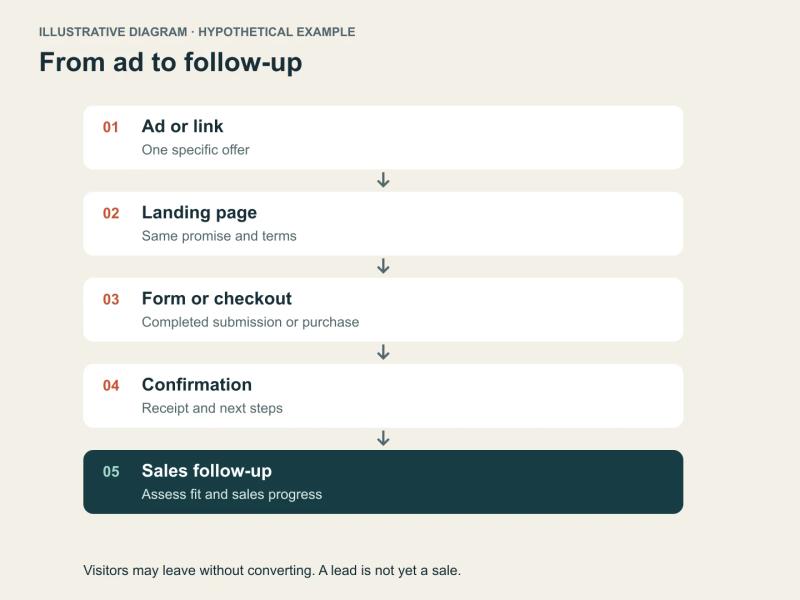
Illustrative flow: visitors can leave without converting, and a lead is not yet a sale.
Landing page FAQs
Do landing page and destination page mean the same thing?
In campaign discussions, people often use both terms for the page visitors reach after clicking a link. A dedicated marketing landing page focuses on a specific offer and action. Analytics tools may use “landing page” for any page where a visit begins.
Does a landing page need its own domain?
You can host it within your company's domain, using a path dedicated to the campaign. Choose the address based on your brand and how you will manage the page. You do not need to buy another domain just because you are creating a landing page.
Can a landing page appear in Google?
Yes, if you allow indexing and Google chooses to include it in search results. A landing page does not guarantee inclusion or a particular ranking. To attract informational searches, prepare content that answers those questions and links to your offer.
How long should a landing page be?
Include the information visitors need to evaluate the offer and take action. A simple download may need less explanation than a service with several conditions. Check whether each section answers a question that affects that decision.
Can I use the same landing page for several campaigns?
Yes, when the campaigns share an offer, audience, and conversion goal. If you change the promise, service, or terms, consider a dedicated version. Identify traffic sources so you can compare inquiries or purchases across campaigns.