Imagine having a digital employee working 24 hours, responding to messages across your favorite communication channels, automating repetitive tasks, analyzing data, and executing concrete actions on your behalf — without you having to be present. That's exactly what OpenClaw promises — the open source AI project that accumulated over 100,000 stars on GitHub in less than two months and became one of the most viral topics in the global tech ecosystem in early 2026.
But beyond the hype, there's something genuinely relevant for entrepreneurs and business leaders: OpenClaw represents a new generation of AI tools that don't just answer questions, but actually do things. And that difference is enormous.
What is OpenClaw and why is everyone talking about it?
OpenClaw is a personal, autonomous, and open source AI assistant that runs on your own infrastructure — your computer, a private server, or a cloud virtual machine. Unlike ChatGPT, Google Gemini, or any other conventional chatbot, OpenClaw doesn't live on third-party servers or process your conversations in any company's cloud. Your data is yours, and the system operates from hardware you control.
The project was created by Peter Steinberger, an Austrian developer known as @steipete, who previously founded PSPDFKit — a document technology company valued at nearly a billion dollars. After stepping away for several years, Steinberger returned to development driven by the AI boom and built, initially for personal use, what is now known as OpenClaw.
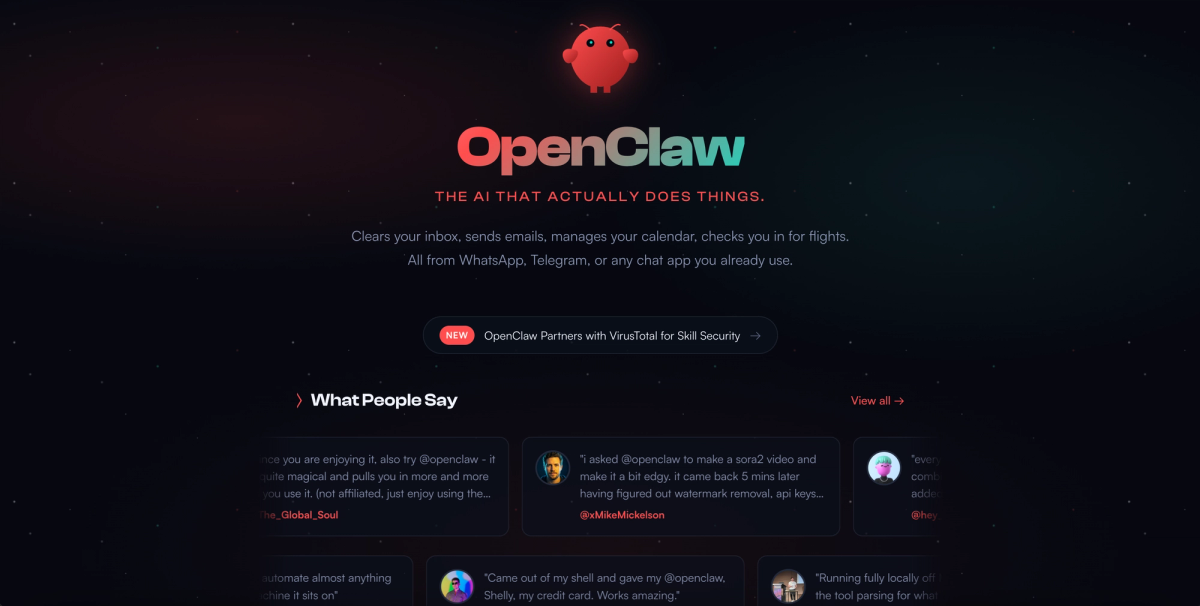
The name has had a rocky history: the project started as Clawdbot, was renamed to Moltbot following a legal dispute with Anthropic (creator of Claude, the AI it was originally named after), and finally settled on the definitive name OpenClaw. The tagline has remained consistent since the start: "the AI that actually does things".
What sets OpenClaw apart from other AI tools isn't the intelligence of the model it uses — it can work with Claude from Anthropic, GPT-4 from OpenAI, or even completely free local models via Ollama — but its ability to execute real actions in your digital environment.
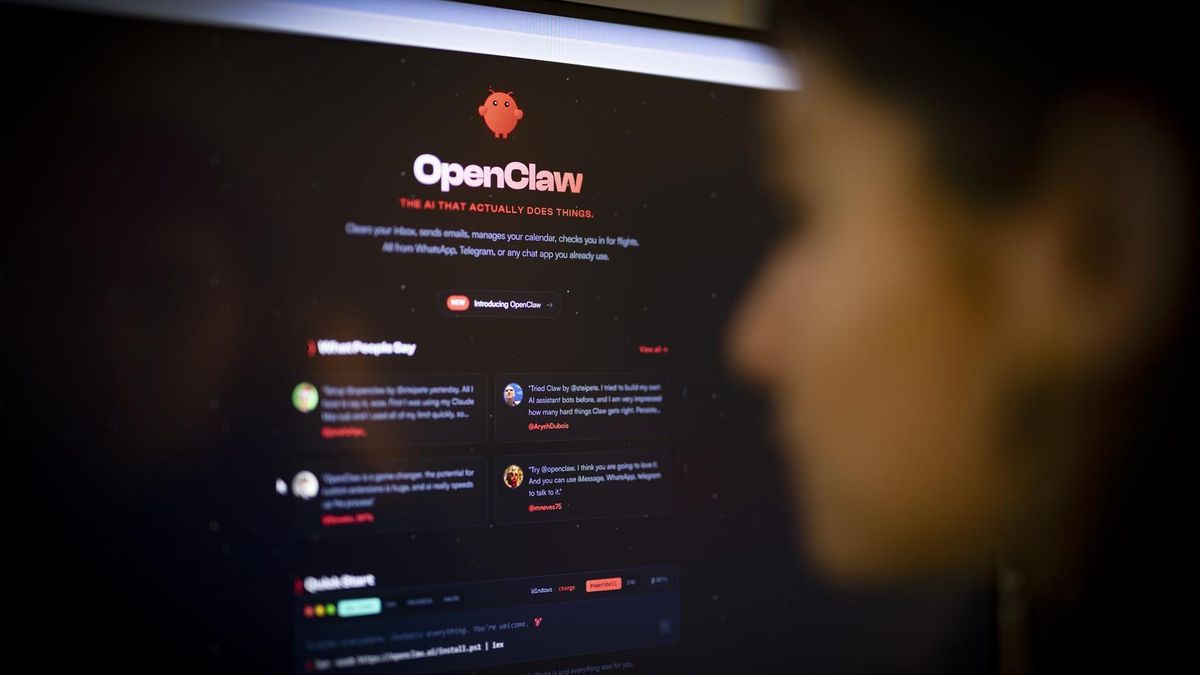
OpenClaw Web
From chatbot to infrastructure: the evolution of AI assistants
Is your business ready for AI?
What you just read, we implement in real businesses. Let's talk about your case.
To understand why OpenClaw is relevant for business, it helps to see the complete picture of how AI assistants have evolved.
Generation 1: the Q&A era
The first AI assistants — Siri, Alexa, ChatGPT — revolutionized access to information. But they have a structural limitation: they are reactive. You ask, they answer. They can't initiate actions, monitor systems, or execute tasks while you're away.
Generation 2: the cloud dependency trap
As AI capabilities expanded, so did the platforms' appetite for your data. Every conversation, every document, every workflow passes through corporate servers. You gain convenience, but surrender control. Your AI assistant knows everything about you, and so does the company hosting it.
Generation 3: the autonomous revolution
This is where OpenClaw operates. This generation represents AI as personal infrastructure: it runs on hardware you control, acts autonomously on your behalf, integrates deeply with your digital environment, and maintains conversation history across 15+ messaging platforms. It's not an assistant that waits — it's one that anticipates, monitors, and executes.
This shift isn't just technological. It's strategic. For a company or entrepreneur, the difference between an assistant that suggests and one that acts can translate into hours of work recovered each week.
How OpenClaw works: architecture and key capabilities
OpenClaw functions as an orchestration layer that connects your preferred AI model with the real world. Its architecture is built on Node.js 22+, TypeScript, and Docker support, making it deployable in virtually any technical environment.
Real task execution
Unlike conventional chatbots that only suggest actions, OpenClaw can execute system commands, write and modify files, control web browsers, access cameras and location services. If Node.js can do it, OpenClaw can orchestrate it.
Unified presence across multiple platforms
OpenClaw integrates with WhatsApp, Telegram, Discord, Slack, Signal, iMessage, Matrix and 15+ additional platforms. This means you can interact with your assistant from the app you already use — on your phone during a trip, on your desktop, or in your team chat — with continuous conversation history across all channels.
Extensible skills ecosystem
The ClawdHub marketplace hosts over 565 skills developed by the community under the open AgentSkills standard. These are downloadable instructions that tell OpenClaw how to perform specific tasks: from automating flight check-ins to posting on social media, analyzing spreadsheets, or integrating with Home Assistant to control smart devices.
Model-agnostic architecture
Users can choose the AI model that best fits their needs: Claude from Anthropic for complex reasoning, GPT-4 from OpenAI for versatility, or completely free local models via Ollama. You can switch providers without reconfiguring the entire system.
Data sovereignty
Every conversation, file, and workflow remains in the user's infrastructure. There are no corporate servers processing interactions, and no surprise changes to terms of service.
OpenClaw Network
Concrete use cases for companies and entrepreneurs
This is where the conversation becomes directly relevant for CEOs, marketing directors, entrepreneurs, and B2B teams. OpenClaw isn't a niche tool for developers — its potential for application in business environments is broad and concrete.
Intelligent email management
An OpenClaw assistant configured to manage your inbox can automatically categorize emails by priority, draft contextual responses based on conversation history, and filter out promotional noise. For a CEO receiving hundreds of emails daily, this could mean recovering one or two productive hours per day.
B2B sales operations automation
Imagine an agent that monitors your CRM, detects inactive leads, drafts personalized follow-up messages, and sends them through the prospect's preferred channel — whether LinkedIn, email, or WhatsApp — all without manual intervention. With OpenClaw and the right skill, this workflow is possible.
Customer support and onboarding
For startups or small-team companies, OpenClaw can serve as a first-line support channel: answering frequently asked questions through Telegram or WhatsApp, escalating complex cases to humans, and logging all interactions in a management system.
Data analysis and automated reporting
The assistant can process spreadsheets, generate visual reports, extract insights from unstructured data sources, and send executive summaries to your team's communication channel every morning — without anyone having to manually run that process.
DevOps and technical monitoring
For product teams or CTOs, OpenClaw can review pull requests, manage deployments, monitor system health, and alert about production issues directly in Slack or Discord, integrating the model's intelligence with your actual technical infrastructure.
Travel and logistics management
A skill already available in ClawdHub automates flight check-ins, organizes itineraries, and monitors travel alerts in real time. For frequently traveling executives, this eliminates a minor but constant operational burden.
OpenClaw vs. conventional AI assistants: which one to choose?
The most common comparison is with ChatGPT, Gemini, or even tools like Zapier or Make. Each occupies a different space.
Feature
OpenClaw
ChatGPT / Gemini
Zapier / Make
Real action execution
✅ Yes
❌ Only suggests
✅ Yes
Privacy / local data
✅ Full control
❌ Corporate cloud
⚠️ Varies
Messaging integration
✅ 15+ platforms
❌ Limited
⚠️ Partial
Flexible AI model
✅ Model-agnostic
❌ Proprietary model
❌ Not applicable
Base cost
✅ Free (open source)
⚠️ Monthly subscription
⚠️ Usage-based/subscription
Requires technical knowledge
⚠️ Moderate-high
✅ None
⚠️ Moderate
OpenClaw's advantage is clear when the use case requires true autonomy, data privacy, and technical flexibility. The disadvantage is the implementation curve: it's not a plug-and-play tool for non-technical users, at least in its current state.
The OpenClaw phenomenon: traction, community, and what's next
OpenClaw's growth has been extraordinary even by open source standards. In less than two months from its public launch, the project accumulated over 100,000 stars on GitHub and more than 11,200 forks — metrics that typically take years for established projects.
The traction was so significant that Cloudflare's stock rose 14% in pre-market trading when the buzz around the project sparked investor enthusiasm about its infrastructure, which developers use to run OpenClaw locally.
One of the most fascinating developments in the ecosystem is Moltbook, a social network where AI assistants can interact with each other. Andrej Karpathy — former director of AI at Tesla — described the phenomenon as "genuinely the most incredible thing related to science fiction I've seen recently", observing how OpenClaw agents self-organize on a Reddit-like platform discussing varied topics, including how to communicate privately.
The project has also begun accepting sponsors with themed tiers ranging from "krill" ($5/month) to "poseidon" ($500/month), with the goal of funding full-time maintainers.
For business leaders, these signals matter: when an open source project moves financial markets, attracts figures like Karpathy, and generates a community of 11,000+ forks in weeks, we're not looking at a technical curiosity — we're witnessing a paradigm shift underway.
OpenClaw Paradigm shift
Security considerations: what every leader should know
Being honest about OpenClaw's current limitations is essential for any serious evaluation. The project is in active development, and its core premise — an assistant that executes real actions on your system — introduces risk vectors that don't exist in conversational chatbots.
The most discussed risk is prompt injection: the possibility that a malicious message sent through WhatsApp or any integrated channel could induce the assistant to take unwanted actions on your system. As Rahul Sood noted in a widely shared analysis, "that it 'actually does things' means it can execute arbitrary commands on your computer".
Steinberger himself has been explicit about this: "remember that prompt injection remains an unsolved problem across the industry". The project has a security best practices guide available in its official documentation.
The team's current recommendation is to run OpenClaw in a controlled, isolated environment, not on the same machine where your primary business credentials are stored. For companies wanting to explore OpenClaw's potential, the most prudent approach is to start with a dedicated virtual server using test accounts, until the project matures its security posture.
Is OpenClaw ready for your business?
The honest answer is: it depends on your technical profile and appetite for experimenting with early-stage technology.
For technical teams — developers, CTOs, startups with internal engineering capacity — OpenClaw already offers tangible and differentiated value. The ability to build custom automations on a model-agnostic foundation, with full data control and no platform costs, is a real competitive advantage.
For non-technical companies — SMEs, entrepreneurs without an engineering team — the optimal adoption window hasn't arrived yet. Installation requires command-line familiarity, and secure operation involves a learning curve that may not be viable without dedicated technical support.
What is applicable today for any business leader is to start understanding the paradigm: AI that acts instead of just answering is the next productivity leap. Staying informed about projects like OpenClaw and being prepared to incorporate it when the adoption curve becomes more accessible is already a strategic decision.
Conclusion: AI no longer just responds, it now acts
OpenClaw is far more than a viral tool. It's a clear signal of where the next generation of AI business tools is headed: toward true autonomy, sovereign privacy, and concrete task execution without constant human intervention.
For entrepreneurs and CEOs, the message is clear: the "I ask AI a question and it answers me" model is being replaced by "I delegate to AI and it executes". Organizations that understand and adopt this paradigm before their competition will have operational, efficiency, and value proposition advantages that will be hard to replicate.
OpenClaw is still at a stage where it requires technical expertise for safe implementation. But the trajectory is unmistakable: what today demands a skilled developer, tomorrow will be available with a few clicks. The question isn't whether this type of automation will reach your business — it's whether you'll arrive prepared.