Helpdesk: Customer Service Software


Bakslash editorial
September 27, 2026
Comparte este artículo
The Fundamental Pillar of Modern Technical Support
In today's technological ecosystem, where digitalization permeates virtually every business aspect, having an efficient support structure has become an imperative necessity. The helpdesk, or support desk, represents that fundamental pillar that sustains operational continuity, guarantees user satisfaction, and optimizes technological resources across any organization.
What is a Helpdesk?
A helpdesk is a centralized resource that provides information and support to end users to resolve issues related to computers, software, services, or specific products. Essentially, it functions as the initial point of contact between users and the IT department, channeling incidents, managing requests, and delivering timely technical solutions.
Helpdesk evolution has been remarkable: from basic telephone call reception systems to sophisticated omnichannel platforms that integrate artificial intelligence, automation, and predictive analytics. Today, the helpdesk concept transcends simple reactive problem-solving to become a strategic component that drives organizational efficiency.

Helpdesk worker
Primary Helpdesk Functions
The responsibilities of a modern helpdesk system are broad and diverse:
1. Incident Management
The operational core of any helpdesk is the ability to register, classify, prioritize, and resolve incidents. This systematic process enables:
- Detailed documentation of every reported issue
- Resource allocation based on urgency and impact
- Establishment of SLAs (Service Level Agreements) to guarantee appropriate response times
- Keeping users informed about the status of their requests
2. Knowledge Base
An efficient helpdesk accumulates solutions to recurring problems, creating a valuable knowledge repository. This solution library:
- Accelerates resolution of similar incidents
- Empowers users with self-service options
- Reduces workload on support agents
- Preserves institutional knowledge despite staff turnover
3. Asset Management
Many helpdesk platforms incorporate features for managing technological inventory:
- Hardware and software tracking
- License control and equipment lifecycle management
- Preventive maintenance scheduling
- Identification of obsolescence and upgrade needs
4. Analysis and Reporting
The helpdesk's analytical capability provides valuable insights for decision-making:
- Identification of patterns in recurring incidents
- Measurement of support team productivity and efficiency
- User satisfaction evaluation
- Justification for investments in technological improvements
Types of Helpdesk
Various helpdesk implementation models exist, each adapted to specific organizational needs:
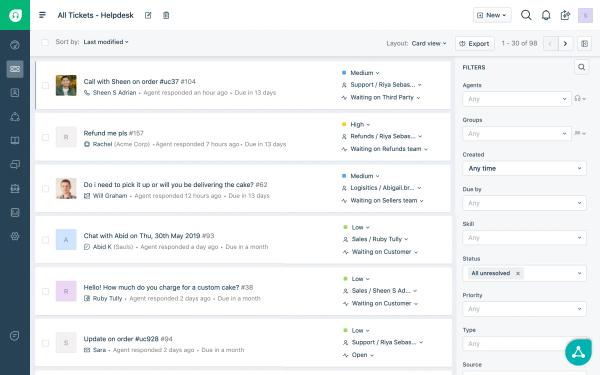
Helpdesk management
Internal Helpdesk
Operated by the organization's own personnel, this model offers:
- Greater control over processes and service quality
- Deep knowledge of infrastructure and organizational culture
- Direct alignment with the company's strategic objectives
- Possibility of complete customization of procedures
External Helpdesk (Outsourcing)
Outsourcing technical support services presents advantages such as:
- Reduction of operational costs
- Access to specialized technical expertise
- Flexible scalability according to demand
- Extended availability (24/7) without internal overhead
Hybrid Helpdesk
Combines internal and external elements to maximize benefits:
- First-line support managed externally
- Escalation of complex cases to internal specialists
- Resource optimization based on function criticality
- Balance between control and operational efficiency
Support Levels in a Helpdesk
A typical helpdesk structure is organized into support tiers or levels, each with specific responsibilities and expertise:
Level 1: First Line
This level constitutes the initial contact with the user and handles:
- Incident registration and classification
- Resolution of basic and recurring issues
- Detailed documentation for possible escalation
- Immediate resolution of simple inquiries
Level 2: Specialized Technical Support
When an incident exceeds first-level capabilities, specialists intervene who:
- Address medium-complexity problems
- Perform deeper technical analysis
- Execute advanced diagnostics
- Resolve most escalated cases
Level 3: Advanced Support
This level involves highly specialized experts who:
- Solve the most complex problems
- Intervene in critical incidents
- Develop customized solutions
- Interact with external vendors when necessary
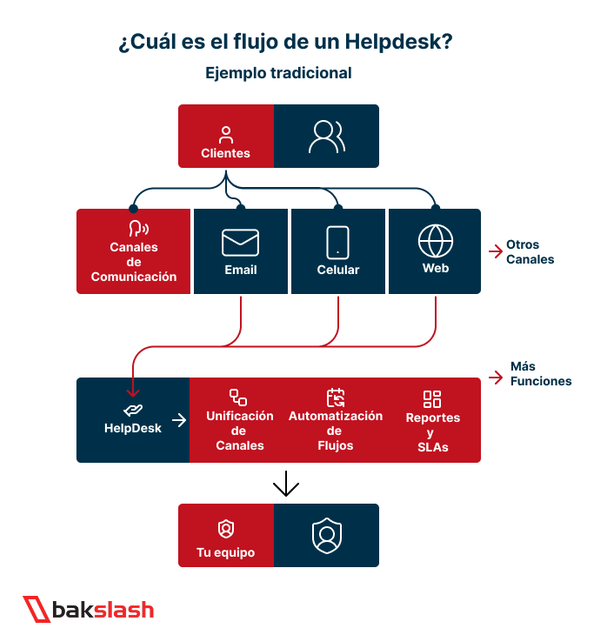
Helpdesk Workflow
Advanced Technologies in Modern Helpdesk Systems
Digital transformation has revolutionized the capabilities of contemporary helpdesk systems:
Artificial Intelligence and Machine Learning
AI integration enables:
- Chatbots for 24/7 support
- Predictive analytics to anticipate issues
- Automatic ticket classification
- Intelligent solution recommendations
Process Automation
Automated workflows optimize operations through:
- Automatic ticket assignment based on competencies
- Programmed escalation based on SLAs
- Intelligent notifications and reminders
- Autonomous resolution of routine incidents
Omnichannel Integration
Modern helpdesks unify experience across:
- Consistency across channels (phone, email, chat, social media)
- Unified history independent of contact channel
- Seamless transitions between communication modalities
- Personalization based on user preferences
Selecting a Helpdesk Solution
When evaluating helpdesk platforms, organizations should consider various factors:
Technical Aspects
- Scalability: Capacity to grow with organizational needs
- Integrations: Compatibility with existing systems (CRM, ERP, monitoring tools)
- Security: Data protection and regulatory compliance
- Availability: Uptime guarantees and backup
Key Features
- Customization: Adaptability to organization-specific processes
- Reporting: Analytical capabilities and report generation
- Self-Service: User portals and knowledge bases
- Mobility: Mobile device access for technicians and users
Financial Considerations
- Licensing model: Per-agent, per-user, or per-ticket volume
- Total cost of ownership: Including implementation, training, and maintenance
- Projected ROI: Expected tangible and intangible benefits
- Payment options: Subscription versus perpetual purchase
Popular Helpdesk Solutions in the Market
The helpdesk platform ecosystem offers options for every organization type:
For Large Enterprises
- ServiceNow: Comprehensive enterprise platform with extensive ITSM capabilities
- BMC Remedy: Robust solution tailored for large corporations
- Jira Service Management: Ideal for technical teams familiar with the Atlassian ecosystem
For Mid-Sized Companies
- Zendesk: Intuitive interface with solid customer support capabilities
- Freshservice: Cloud-based solution with quick deployment and easy scalability
- ManageEngine ServiceDesk Plus: Balance between advanced features and usability
For Small Businesses and Startups
- Freshdesk: Lighter version focused on simplicity and customer experience
- Zoho Desk: Part of the Zoho ecosystem, with good cost-benefit balance
- HubSpot Service Hub: Natural integration with marketing and sales tools
Open Source Solutions
- GLPI: Complete open-source platform with extensive ITSM capabilities
- osTicket: Lightweight and customizable ticketing system
- Request Tracker (RT): Mature system with solid track record in the open-source community
Best Practices for Helpdesk Implementation
Successful helpdesk implementation requires:
Strategic Planning
- Define clear and measurable objectives
- Identify key stakeholders and specific needs
- Establish realistic success metrics
- Develop a phased implementation roadmap
User Adoption
- Provide adequate training for technicians and end users
- Effectively communicate system benefits
- Gather constant feedback for improvements
- Celebrate early wins to foster adoption
Continuous Optimization
- Periodically review processes and procedures
- Regularly update the knowledge base
- Refine categories and classifications as the organization evolves
- Implement incremental improvements based on data analysis
The Future of Helpdesk
Trends that will define helpdesk system evolution include:
Hyperautomation
The combination of AI, RPA (Robotic Process Automation), and advanced analytics will enable:
- Autonomous resolution of increasingly higher percentages of incidents
- Proactive processes for problem detection and correction
- Continuous learning to improve operational efficiency
Predictive Experience
Helpdesks will evolve toward anticipatory models:
- Problem detection before affecting users
- Personalized recommendations based on usage patterns
- Predictive infrastructure maintenance
Immersive Support
Immersive technologies will transform technical assistance:
- Augmented reality to guide physical problem resolutions
- Shared virtual environments for technical collaboration
- Advanced visualization of complex systems
Conclusion
The helpdesk has evolved from a simple technical problem reception point into a sophisticated ecosystem that directly impacts organizational productivity, satisfaction, and efficiency. In a business environment where technological dependency continues to grow, having a robust, efficient helpdesk system adapted to an organization's specific needs is not a luxury but a strategic necessity.
Organizations that recognize the transformative value of a well-implemented helpdesk gain significant competitive advantages through greater service availability, faster problem resolution, and better technological resource utilization. Ultimately, an effective helpdesk not only resolves technical issues but empowers the organization to focus on its core business objectives.
Selecting and implementing the right solution, accompanied by well-defined processes and trained personnel, constitutes an investment that generates tangible returns in the form of operational efficiency, user satisfaction, and technological resilience in an increasingly digitalized world.