Page Agent The New Web

Bakslash editorial
May 21, 2026
Comparte este artículo
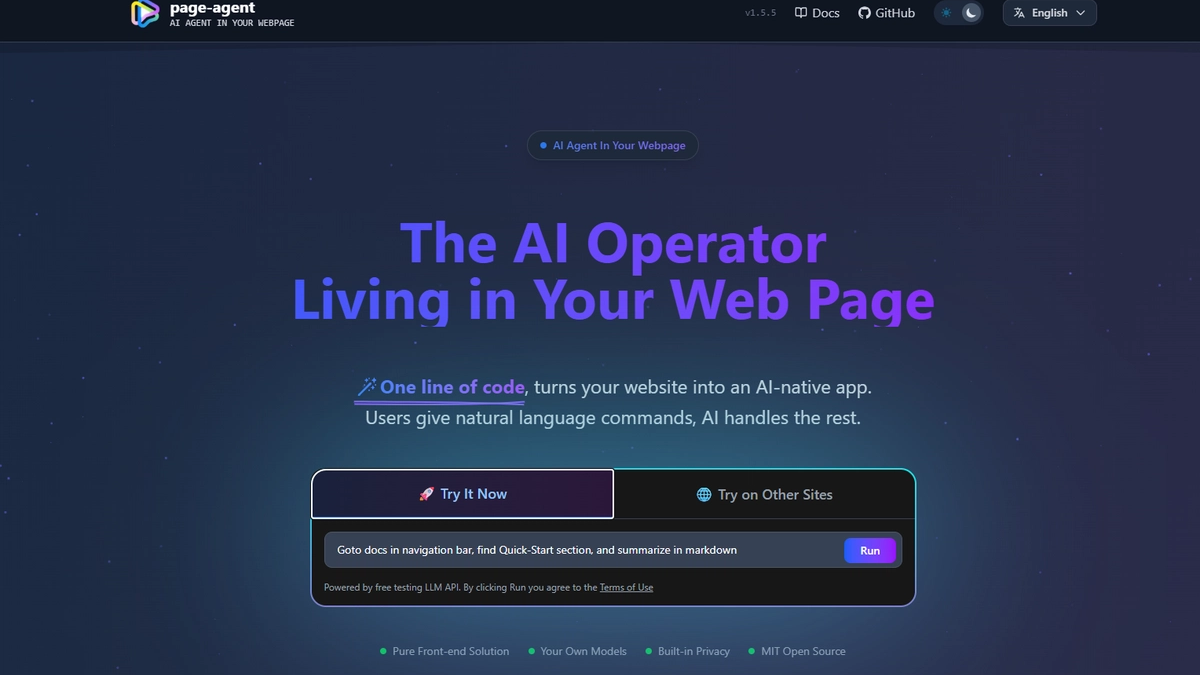
Web interfaces have followed the same fundamental logic for decades: users learn how the system works and operate it manually. PageAgent breaks that paradigm entirely. This open-source library, developed under Alibaba's GitHub organization, introduces an AI agent for web applications that lives directly inside the frontend and can click, type, navigate, and complete entire workflows from a single natural language instruction.
For companies looking to modernize their digital platforms, reduce user friction, or stay ahead of the new standard for AI-native interfaces, PageAgent is no longer a laboratory experiment. It is production-ready software available today.
What Is PageAgent and What Makes It Different?
PageAgent is an MIT-licensed JavaScript library that embeds an AI agent directly into the frontend of any website or web application. Its creator, who works at Alibaba, described the vision clearly:
"The GUI agent that lives inside your web page."
That distinction matters. Most web automation tools today operate from the outside — Playwright, Puppeteer, and similar frameworks control the browser as an external system. PageAgent takes the opposite approach.
By running inside the page itself, the agent inherits the user's active session natively. This makes it especially powerful for modern single-page applications (SPAs) and authenticated platforms where external automation tools often break or require additional credential management.
The AI agent for web applications can:
- Understand natural language instructions
- Interact with the DOM in real time
- Navigate interfaces without relying on screenshots
- Execute complete workflows autonomously
- Work with multiple AI providers: OpenAI, Claude, Ollama, Qwen, and DeepSeek
The Problem PageAgent Solves
To understand why PageAgent matters, it helps to understand why the web has struggled to adapt to the rise of AI agents.
Most AI agents today operate externally. When they interact with websites, they typically rely on screenshots and visual interpretation, simulating keyboard and mouse actions like a human user would.

Page Agents IA
This creates three critical limitations:
Fragility Under UI Changes
Small interface or layout changes can break the agent because it depends on visual recognition rather than understanding the actual structure of the page.
High Computational Cost
Analyzing screenshots requires significantly more processing power and tokens than reading structured information directly from the DOM.
Lack of Session Context
External agents do not inherit the user's authenticated session or application state, forcing developers to manage credentials and permissions separately.
PageAgent solves all three with a DOM-first architecture. Instead of analyzing screenshots, it performs what the project calls "DOM dehydration," converting the page structure into lightweight semantic representations that AI models can interpret far more efficiently and accurately. And because the agent runs inside the page, it automatically inherits the active session and application context.
How PageAgent Works
PageAgent's architecture is practical and accessible for any development team.
The Agent Core
At the center of the system is PageAgentCore, which handles AI logic and orchestration. The process is straightforward:
- The user provides a natural language instruction
- The configured LLM interprets the request
- The controller executes actions directly on the DOM
The controller can click elements, type text, scroll pages, read interface state, and navigate complete workflows — all in real time.
The User Panel
PageAgent includes a floating interface panel where users can type instructions directly inside the application. This UI layer is decoupled from the core agent logic, allowing developers to customize or completely replace the interface depending on the product experience they want to create.
Chrome Extension Support
For workflows involving multiple tabs or browser-wide actions, PageAgent includes a Chrome extension that acts as a bridge between the embedded agent and the browser environment. This allows the agent to coordinate workflows across pages while operating under explicit user authorization.
Implementation in Four Lines
One of the most compelling aspects of PageAgent is how simple the setup can be:
import { PageAgent } from 'page-agent'

const agent = new PageAgent({
  model: 'gpt-4o',
  baseURL: 'https://api.openai.com/v1',
  apiKey: 'YOUR_API_KEY',
  language: 'en',
})

await agent.execute(
  'Fill out the contact form using the customer information'
)A single natural language instruction translates automatically into multiple coordinated interface actions.

Page Agents Integrations
Real Business Use Cases
PageAgent is not an experimental demo. Its implications for businesses and digital platforms are concrete and measurable.
Interactive Onboarding Without Static Tutorials
Instead of rigid product tours or documentation nobody reads, users can simply ask: "How do I set up my profile?" The agent navigates the interface step by step in real time, guiding the user directly inside the application.
For SaaS platforms and enterprise software, this can dramatically reduce activation friction and early churn. Research across the sector shows that up to 60% of churn happens within the first seven days of use — precisely during the onboarding phase.
Customer Support That Acts Instead of Answering
Traditional support answers questions. An AI agent for web applications can perform the task directly.
If a user says: "I can't find where to download my invoice", the agent can navigate the application and complete the action inside the user's active session, without the user needing to learn where to go.
Legacy System Modernization
Many companies still rely on internal ERP systems, CRMs, and administrative platforms with outdated interfaces. PageAgent creates the possibility of adding a natural language interaction layer without rebuilding the underlying system.
Employees simply describe what they want to do, and the agent handles the interface complexity. For operations teams with non-technical staff, the productivity impact can be immediate.
Workflow Automation for Repetitive Processes
Exporting reports, updating records, generating dashboards, managing administrative tasks — any repetitive workflow can be delegated to an embedded agent through plain language instructions. For operations, marketing, and sales teams, this represents a significant productivity opportunity without additional external tooling.
Improved Accessibility
PageAgent also has strong accessibility implications. Combined with speech-to-text systems, users with motor or visual impairments could control complex interfaces using voice or text instructions, rather than manually navigating difficult UI structures.
Conversational QA and Testing
For development teams, PageAgent introduces the possibility of writing interface tests in natural language instead of brittle automation scripts.
Instead of coding a complex test flow, teams could simply write: "Verify that the payment flow works correctly for a new customer." This opens the door to more maintainable tests that non-technical team members can also contribute to.
Why the "Inside-Out" Approach Changes Everything
What makes PageAgent especially important is not just the technology itself, but the design philosophy behind it.
Most AI experiences on the web today are external assistants living beside the application — chatbots that can answer questions but cannot truly interact with the platform itself.
PageAgent proposes the opposite model: the agent becomes part of the application. It understands the interface structure, inherits the user context, and can act with the same permissions as the user.
This fundamentally changes the relationship between humans and software.
Graphical interfaces stop being the only interaction layer and become environments where both humans and AI agents can operate collaboratively.
For businesses, this has direct implications for:
- Product design: interfaces must be understandable by both humans and agents
- User experience: the learning curve shrinks to near zero
- Accessibility: more people can interact with complex software
- Operational efficiency: repetitive workflows are delegated without external tools
- Customer retention: onboarding and support become smoother and more effective
Platforms that adopt agent-native experiences at this early stage may gain a significant competitive advantage as AI interaction becomes a standard expectation across the web.
Who Should Adopt PageAgent Now?
The library is open-source and production-ready. But not all organizations are equally prepared to adopt it.
SaaS companies with high early churn: if users drop off in the first days, an embedded agent that guides them in real time can be a turning point.
Platforms with non-technical end users: the more complex the interface for the final user, the greater the value of a natural language layer.
Development teams with legacy systems: instead of a costly rewrite, PageAgent allows modernizing the interaction experience without touching the backend.
Companies already using generative AI internally: if there is existing AI culture and familiarity, adopting embedded agents is a natural next step.
Businesses with repetitive operation-heavy workflows: administration, reporting, data updates — any manual flow repeated more than ten times a day is a candidate for agent automation.
Frequently Asked Questions About PageAgent
Does PageAgent require modifying my application's backend? No. PageAgent operates exclusively on the frontend. No changes to server logic or databases are required.
Which AI models are supported? It currently supports OpenAI (GPT-4o and others), Anthropic's Claude, Ollama for local models, Qwen, and DeepSeek. The architecture is designed to be provider-agnostic.
Is it safe for the agent to operate inside the user's session? The agent acts with the same permissions as the active user — it does not escalate privileges. For multi-tab workflows, the Chrome extension requires explicit user authorization.
How difficult is implementation? For a developer familiar with modern JavaScript, basic integration can be done in hours. The library is published on npm and its documentation is accessible.
Can PageAgent be used in mobile applications? It is currently designed for web environments. Hybrid or progressive web apps (PWAs) are compatible, but native iOS/Android apps are outside the project's current scope.
Is PageAgent free to use? The library itself is free and open-source. Costs come from usage of the AI provider API you configure (OpenAI, Anthropic, etc.).
The Future of Web Interfaces Is Conversational
PageAgent is one of the clearest signals yet that the next generation of web experiences will not be designed exclusively around clicks, menus, and manual navigation.
They will also be designed for natural language instructions and autonomous execution.
An AI agent for web applications that understands your interface structure, inherits user context, and completes entire workflows from a single sentence is no longer science fiction. It is open-source software that is ready for production today.
For organizations looking to modernize digital experiences, reduce onboarding friction, improve accessibility, or prepare for the standard that is coming, exploring technologies like PageAgent is becoming less of an option — and more of a competitive decision.
The question is not whether the web will become more intelligent. The question is whether your platform will be ready when it does.
Conclusion: The Intelligent Web Is No Longer a Promise It's Production Code
PageAgent is the most concrete proof yet that the next generation of web interfaces will not be designed only for mouse clicks — it will also be designed for natural language instructions. An AI agent that lives inside your application, knows its structure, inherits the user's session, and can execute complete workflows from a single sentence is not science fiction: it is an MIT-licensed library you can install today. For businesses looking to improve engagement, reduce onboarding friction, modernize legacy systems, or simply understand where the industry is heading, exploring PageAgent is a smart strategic decision. The entry cost is low (it is free and open source), the potential is high, and the learning curve is manageable for any team with basic technical capacity. The web as we know it is about to become significantly more intelligent. The question is whether your organization will be ready to take advantage of it.